Agranoff On The Sandman

I can tell you've got the itch, Kid, that you'd like to be a jock.
Well, give it up, the magic's gone, there's nothing left but schlock.
You deal with all the crazies, and the drugged-out suicide calls,
And the sponsors and the FCC have got you by the throat.

Programming tells you what to play, and they take no denying.
You read copy advertising crap you'd never think of buying.
The hours are long, the pay is squat, vacations are... but then
The cut would end, he'd face the mike, and weave magic once again.

- Mike Agranoff, Ballad of the Sandman

Geraghty Quoting Obama On Fundraising

Increasingly, I [Obama] found myself spending time with people of means - law firm partners and investment bankers, hedge fund managers and venture capitalists.


As a rule, they were smart,interesting people, knowledgeable about public policy, liberal in their politics, expecting nothing more than a hearing of their opinions in exchange for checks. But they reflected, almost uniformly, the perspectives of their class; the top 1 percent or so of the income scale that can afford to write a $2,000 check to a political candidate.


They believed in the free market and an educational meritocracy; they found it hard to imagine that there might be any social ill that could not be cured with a high SAT score. They had no patience with protectionism, found unions troublesome, and were not particularly sympathetic to those whose lives were upended by movements of global capital. Most were adamantly prochoice and were vaguely suspicious of deep religious sentiment…


I know that as a consequence of my fund-raising I became more like the wealthy donors I met, in the very particular sense that I spent more and more of my time above the fray, outside the world of immediate hunger, disappointment, fear, irrationality, and frequent hardship of the other 99 percent of the population - that is, the people I’d entered public life to serve.


- Barack Obama, The Audacity of Hope, page 114

symbolset On Bits vs. Fictons

Well, actually, the quantum unit of information is a bit.
No, the binary quantum unit of information is a bit. A ficton is several orders of magnitude "smaller" than that. A bit can be true or false. A light that's on or off. A ficton is a value that represents the smallest possible division of "possibly true".

The universe is not binary at a very fine scale. Things fade in and out of frame with increasing and decreasing probability in the present moment. It's only when the arrow of entropy has passed and the frame is set that a thing was or was not, from our point of view.

Ken On Contradiction

Cleave is such an interesting word; it is it's own opposite: To cling to, to separate.

Unknown on Reproducibility

The Plural of anecdote is not data.

Shaw On Elietism

Every profession is a conspiracy against the laity.

-George Bernard Shaw

Coleridge On Architecture


Kubla Khan
OR, A VISION IN A DREAM.
A FRAGMENT.

In Xanadu did Kubla Khan
A stately pleasure-dome decree :
Where Alph, the sacred river, ran
Through caverns measureless to man
Down to a sunless sea.
So twice five miles of fertile ground
With walls and towers were girdled round :
And there were gardens bright with sinuous rills,
Where blossomed many an incense-bearing tree ;
And here were forests ancient as the hills,
Enfolding sunny spots of greenery.

But oh ! that deep romantic chasm which slanted
Down the green hill athwart a cedarn cover !
A savage place ! as holy and enchanted
As e'er beneath a waning moon was haunted
By woman wailing for her demon-lover !
And from this chasm, with ceaseless turmoil seething,
As if this earth in fast thick pants were breathing,
A mighty fountain momently was forced :
Amid whose swift half-intermitted burst
Huge fragments vaulted like rebounding hail,
Or chaffy grain beneath the thresher's flail :
And 'mid these dancing rocks at once and ever
It flung up momently the sacred river.
Five miles meandering with a mazy motion
Through wood and dale the sacred river ran,
Then reached the caverns measureless to man,
And sank in tumult to a lifeless ocean :
And 'mid this tumult Kubla heard from far
Ancestral voices prophesying war !

The shadow of the dome of pleasure
Floated midway on the waves ;
Where was heard the mingled measure
From the fountain and the caves.

It was a miracle of rare device,
A sunny pleasure-dome with caves of ice !
A damsel with a dulcimer
In a vision once I saw :
It was an Abyssinian maid,
And on her dulcimer she played,
Singing of Mount Abora.
Could I revive within me
Her symphony and song,
To such a deep delight 'twould win me,

That with music loud and long,
I would build that dome in air,
That sunny dome ! those caves of ice !
And all who heard should see them there,
And all should cry, Beware ! Beware !
His flashing eyes, his floating hair !
Weave a circle round him thrice,
And close your eyes with holy dread,
For he on honey-dew hath fed,
And drunk the milk of Paradise.

- Samuel Taylor Coleridge

Dr. William Dement On Dreams

Dreaming permits each and every one of us to be quietly and safely insane every night of our lives.

Williams On Hyperinflation

Williams reverse-engineers the GDP, employment and inflation data for more accurate readings. He backs out manipulative changes to produce more valid figures. Take the 5.5% May unemployment rate for example. BLS calculates it on persons who looked for work in the last 30 days. Williams adds those who want to work but gave up in frustration plus people working part-time who want (but can't find) full-time jobs. Result: real unemployment of over 12%.

M3 (the broadest money supply measure) growth is so high that the Fed no longer reports it. Economists like Williams do because it's crucial to know, and the data he reveals are disturbing - record M3 growth at a near 18% annual pace. Hyperinflationary seeds are now sown. Dollar valuation is falling, and at some point may accelerate when investors flee it for safer havens. The Fed again will respond. More debt will be monetized. It will build over time. Things will get worse and then be exacerbated when the government is less able to meet its obligations. "Therein lies the ultimate basis for the pending hyperinflation," in Williams' judgment.


Things are so out of hand, Williams sees "no way of avoiding a financial Armageddon." We're nearly or already bankrupt; are creating money to cover our obligations; the more we print, the more we need; it's fiat currency unbacked by gold; and every new dollar created dilutes the value of all others in circulation. Double the money supply, and presto - every dollar is worth 50 cents. Double it again, and you get the point. We've been doing it for decades, especially since Nixon closed the gold window in 1971.

At some point, the music stops, the dollar collapses, it becomes worthless paper, and related dollar-demoninated paper assets go down with it. Williams quotes a law professor who experienced Weimar Germany's hyperinflation first hand. It was the worst by far ever recorded. "It was horrible. Horrible! Like lightening it struck. No one was prepared." Shelves in grocery stores emptied. "You could buy nothing with your paper money." At the trough in 1923, the mark plunged to an astonishing 4,200,000,000,000 to the dollar.

Futurepower(R) On "One Night In Bangkok"

The song is about a real event. One year the world chess championship was held in Thailand. The men went out at night, and were not prepared for the experience of being treated with gentleness. The Dalai Lama says that Thai people are gentle, and he's right.


I've seen it myself. One night, a long time ago, standing on the corner of Patpong road, a western woman was trying to get control over her western man again after he had seen in a Thai bar that a woman could be truly gentle with a man. All the man had known in his entire life, apparently, was women being harsh with men.

Justin Frank On Splitting

From early infancy, we try to organize our internal world, a need that persists throughout life. At first we simplify that world, turning our experiences into good and bad, comfort at our mother's presence and discomfort in her absence.


This attempt to order psychic life into good and bad experiences is called splitting, and it is a fundamental way to make sense of different emotions by keeping opposite feelings separate from one another. This protects the child from feeling confused or anxious that his bad feelings will destroy his good ones.


When children divide up into teams of good guys and bad guys, they are splitting. When parents divorce, some children have to see one parent as the victim and the other as the victimizer in order to manage their fears and confusion. Whatever the circumstance, as children we all learn to split in order to manage anxiety. It is normal and a necessary part of emotional growth.


[...] People split between idealization and demonization. Before the age of five, most children idealize their parents as powerful people without fault. Idealization facilitates growth and development, enabling the child to identify with the strengths of a parent. At the same time idealization keeps aggressive or murderous feelings from reaching the child's consciousness. The child thus avoids guilt feelings, remaining unaware of potentially destructive wishes against his perfect caregivers.


But when the child becomes disillusioned with his parents - it usually happens around the age of five - organized patriotism, religious indoctrination, or team sports are there to pick up the pieces and form bases for new idealizations that protect the child from disappointment and anger. In healthy environments the child eventually gains perspective on parental faults.

Orlando Gibbons On The Swan Song

The silver Swan, who living had no Note,

when Death approached, unlocked her silent throat.

Leaning her breast against the reedy shore,

thus sang her first and last, and sang no more:

"Farewell, all joys! O Death, come close mine eyes!

"More Geese than Swans now live, more Fools than Wise."

- Orlando Gibbons


Wikipedia: The phrase "swan song" is a reference to an ancient belief that the Mute Swan (Cygnus olor) is completely mute during its lifetime until the moment just before it dies, when it sings one beautiful song. http://en.wikipedia.org/wiki/Swan_song

Alice Bag On Chola Style


But Chola style can be fierce - just ask Gwen Stefani, who incorporated elements of it at one time.

Growing up in East LA, I got to see the real thing and Cholas can pull off a strong, beautiful warrior style like no one else.

Keedwell On The Benefits Of Depression

[D]epression is not a human defect at all, but a defence mechanism that in its mild and moderate forms can force a healthy reassessment of personal circumstances.

[...] There are benefits and that's why it has persisted. It's a tough message to hear while you are in depression but I think that there's a life afterwards

I have received e-mails from ex-sufferers saying in retrospect it probably did help them because they changed direction, a new career for example, and as a result they're more content day-to-day than before the depression.

One woman left an abusive relationship and moved on and might not have done if depression had not provided the necessary introspection.

Similarly, unrealistic expectations are revised when depression sparks a more humble reassessment of strengths and weaknesses.

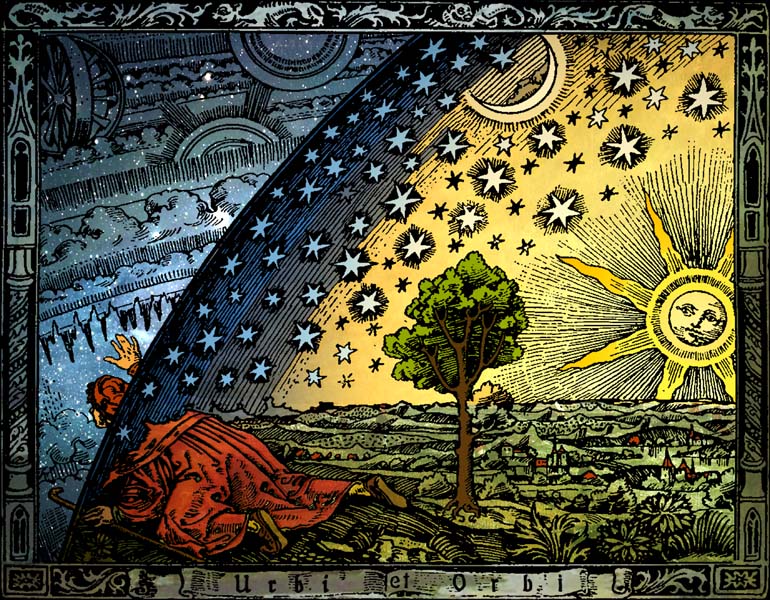
The Flammarion Woodcut

Peter Mayle On Love's Hunger

I would like a lifetime spent
with an irrational and suspicious goddess.

Some short-tempered jealousy on the side.

A bottle of wine that tastes like you
and a glass that's never empty.

Leif Parsons On Lying

Liars change the subject quickly. Liars look up and to their right when they speak. Liars use fewer contractions. Liars will sometimes stare straight at you and employ a dead face. Liars never touch their chest or heart except self-consciously. Liars place objects between themselves and you during a conversation.

Peter Moskos On Police Use Of Force

I have three main problems with Tasers: 1) they’re used too readily, 2) the pain they cause isn’t geared toward the compliance I want, and 3) people die.

[...] If I followed departmental policy, I could have maced about 3 people a shift. Instead, I maced one person in 14 months. Mace has a natural check and balance: it goes everywhere. No officer quick with the mace will be popular in the department for long.

Physical force can often be done without too much pain. And the pain caused is directly proportional to your resistance. For instance, I need you to put your hands behind your back. I use force. Force isn't the same as pain. It might hurt if you fight it. But as soon as you stop resisting, any pain is over.

Officers use Tasers quicker than they otherwise would apply hands-on force. "Comply or I Taze you." You don't comply so I Taze. Clean and legal. But wrong because it's not necessary.

We're talking about pain compliance... hurting somebody. Tasers cause pain as punishment. That's not right. We shouldn’t pretend that causing pain is clean process. It never is.

Force is part of the police job. No suspect puts handcuffs on himself.

Without a Taser, I just say "Comply." You don't. So I keep talking to you, cajoling you, ordering you, threatening you. But the point is I'll work harder trying to convince you to comply if my only alternative is hands-on force. Officers *should* be reluctant to use force. You don't want to use physical force because there is some danger... and also you break a sweat--something you always want to avoid while wearing body armor. Departmental regulation be damned! It’s too easy to press a button.

When I do use hands-on force, at least my force is geared toward getting you to do what I want (like getting your arms behind your back so I can cuff you). With a Taser, it's just about disabling pain. That's torture. And consider this, it's not easy to follow instructions after being in the greatest pain of your life. So you get tazed again.

Moyers On Regan's Legacy

Reagan's story of freedom superficially alludes to the Founding Fathers, but its substance comes from the Gilded Age, devised by apologists for the robber barons. It is posed abstractly as the freedom of the individual from government control--a Jeffersonian ideal at the root of our Bill of Rights, to be sure. But what it meant in politics a century later, and still means today, is the freedom to accumulate wealth without social or democratic responsibilities and the license to buy the political system right out from under everyone else, so that democracy no longer has the ability to hold capitalism accountable for the good of the whole.

Overheard In Bermuda

Donald: There, you just heard it from the horse's mouth.

Kevin: Did you just call Calvin a horse?

Calvin: Nay.

Cary Tennis On Adaptation

[...]And the dizzying confusion foist upon us by artworks of chaos and seeming randomness -- that too is instructive. For it is that same dizzying confusion that comes upon us when our accustomed structures of family and work threaten to collapse. In the midst of it we learn to maintain a calm surface -- even as our skin is burned off and our bodies disappear in the flames.

Ah. That's the trick! Maintaining!

At first nothing happens. You stand in the fire of art and all that happens is you burn. That is no fun. But then you see it's not just you that is burning: Something around you is being burned away. Layers of assumption and fear and grime are being burned away. As you burn, you start to see the sculpture in a new way.

TheLink On Social Networking

Many animals willingly engage in potentially risky behaviours to increase their odds of mating.

Fanning out a brightly coloured tail, making loud noises, dancing and many many other things that make them more obvious to potential mates, but at the same time more vulnerable to predators.

Posting pictures of yourself in panties, passed out or french kissing on a "social" website is about the same thing.

Anonymous On Soft Bribery

Note that there are always certain people with disproportionate voices - these people are really hurting them. How can they turn them around?

They can't outright bribe them. That's illegal and probably wouldn't work anyway - people would feel insulted. So what they need to do is ensure that the "thought leader"'s economic interest is aligned with their own.

We see this happen all the time - a previous strong advocate against something, in this case pro ODF and against OOXML, will suddenly get more concilatory. See Durusau's change of tone for an example. Now I don't know him, but I'm pretty sure here's what happened.

He would be in constant contact with the OOXML team in MS just as a matter of course. One day, though, they'll tell him to expect a call from a VP or higher - big guns. He's excited to be able to reach higher up in the company. Finally, they're taking him seriously. He might be talking to a billionaire!

He'll get the call. "Wow, we're really impressed with your work on this. My team is always telling me what a smart, together guy you are", says the VP or Partner or whatever. "I just wanted to tell you that we really appreciate the work you're doing and we can learn a lot from you. Say, when this is all over, if OOXML finally gets accepted - we'd love to get you in for some interoperability training and consulting, our staff could really use your insight. We pay pretty well, $500 an hour, and we estimate the contract would last for a year fulltime, but we're flexible with your current work - we just need you on call. What do you think?"

There you go. That's it. A year's worth at $500/hr is close enough to a million bucks, the guy's got a mortgage, game over. Of course MS wants it kept quiet or the deal's off - that's their "standard business practise", and the contract has an NDA clause.

Why Bubbles Are Bad

An air embolism, or more generally gas embolism, is a medical condition caused by gas bubbles in the bloodstream (embolism in a medical context refers to any large moving mass or defect in the blood stream).

Small amounts of air often get into the blood circulation accidentally during surgery and other medical procedures, but most of these in veins are stopped at the lungs, and a venous air embolism that shows symptoms is very rare.

Death may occur if a large bubble of gas becomes lodged in the heart, stopping blood from flowing from the right ventricle to the lungs (this is similar to vapor lock in engine fuel systems). However, the amount of gas necessary for this to happen is quite variable, and also depends on a number of other factors, such as body position.

Gas embolism into an artery, termed arterial gas embolism, or AGE, is a more serious matter than in a vein, since a gas bubble in an artery may directly cause stoppage of blood flow to an area fed by the artery. The symptoms of AGE depend on the area of blood flow, and may be those of stroke or heart attack if the brain or heart, respectively, are affected.